

Law Firm Website Redesign

Dan Gilroy Design redesigns websites for law firms and attorneys whose current site no longer reflects the practice. A redesign keeps what the existing site still does well, especially the pages people already find in search, and rebuilds the rest as a custom WordPress site the firm can run itself.

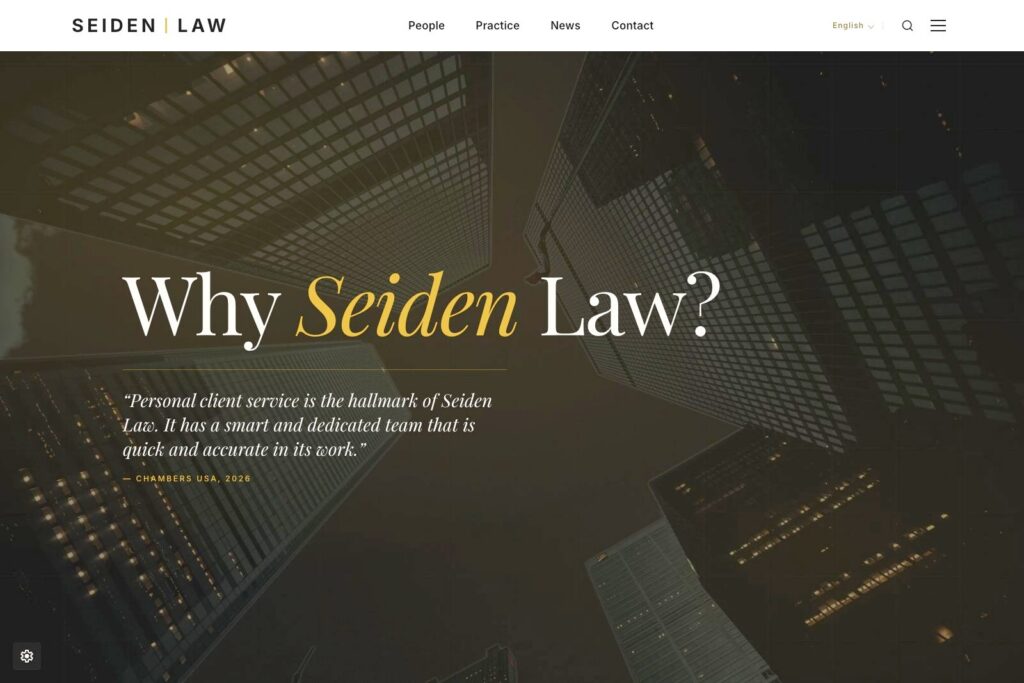
Seiden Law LLP page after the redesign
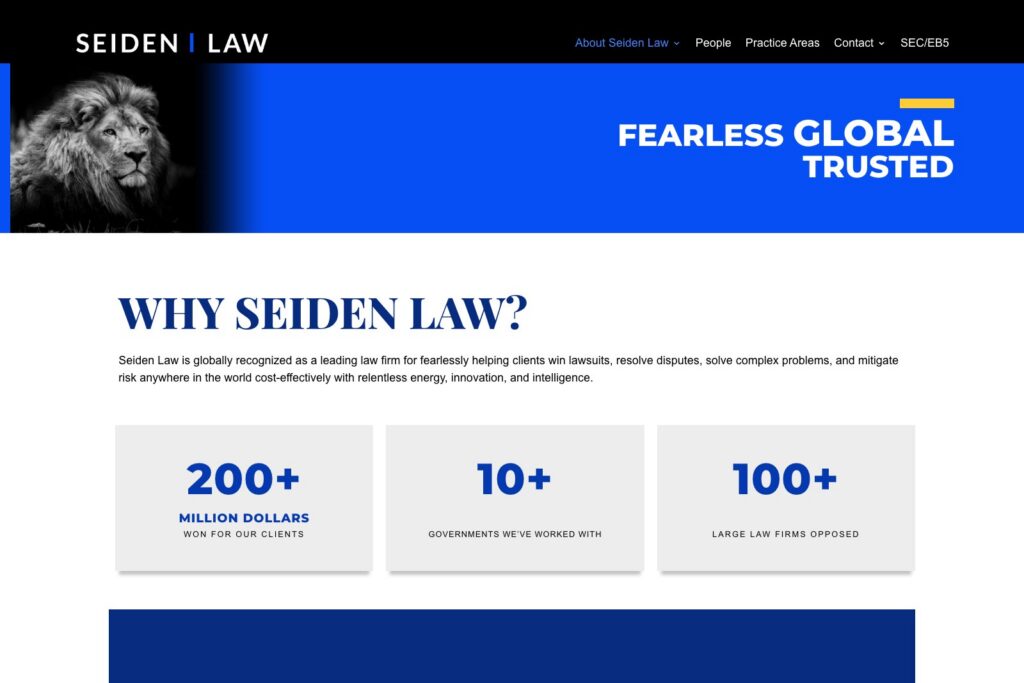
Seiden Law LLP page before the redesign

Before Why Seiden Law page, pre-launchAfter Why Seiden Law page, post-launch

Four recent redesigns

Four recent law firm website redesigns, from a two-attorney defense practice to a Houston trial firm of more than 40 attorneys.

Conlin McKenney & Philbrick: an Ann Arbor firm since 1937, and a homepage that leads with it

CMP is an Ann Arbor, Michigan firm with roots dating to 1937. Its attorneys serve individuals, businesses and institutions across Southeast Michigan, in practices from business law and litigation to family law and estate planning. The redesign launched in 2026.
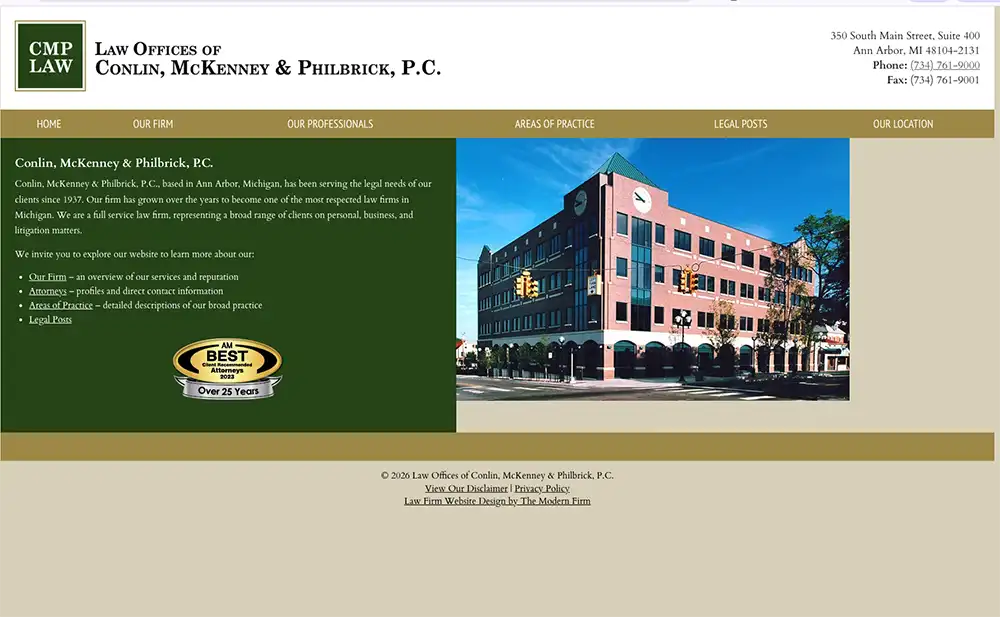
Before Conlin McKenney & Philbrick, PC homepage before the redesign
Homepage captured August 31, 2026
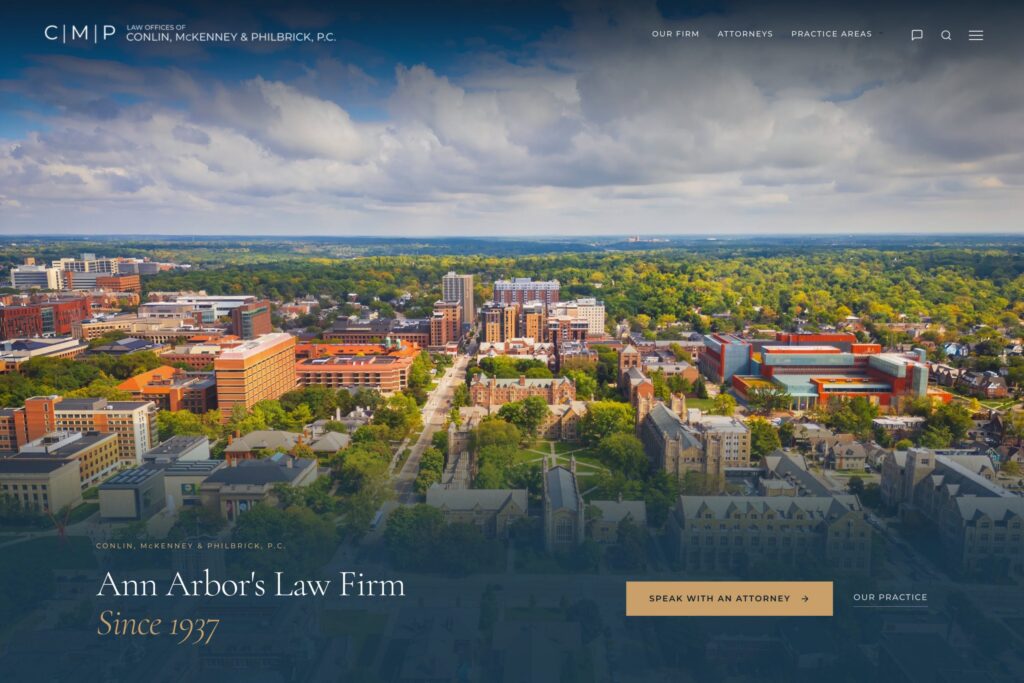
After Conlin McKenney & Philbrick, PC homepage after the redesign
Homepage captured October 29, 2026

Problem

The previous homepage introduced the firm through a compact block of small text, a list of links and an office photograph. The firm's history and broad practice were all there, but the dense layout gave visitors little guidance and left the connection to Ann Arbor understated.

Constraint

Eight practice areas and a full roster of attorneys had to stay one step from the homepage without turning it into a directory.

Decision

Lead with a panoramic view of Ann Arbor and the line "Ann Arbor's Law Firm Since 1937," set in larger type with more room, and give the practice areas and a conversation with an attorney prominent links.

Michelle Whitley Michelle Whitley Office Manager, Conlin, McKenney & Philbrick, P.C. Ann Arbor, MI Google Review, November 2026

Dan did a huge redo of our website including bio's, design layout and re-writing content. … He turned our very dated site into a refreshed and modern feel, really showing off the historical side of our firm.
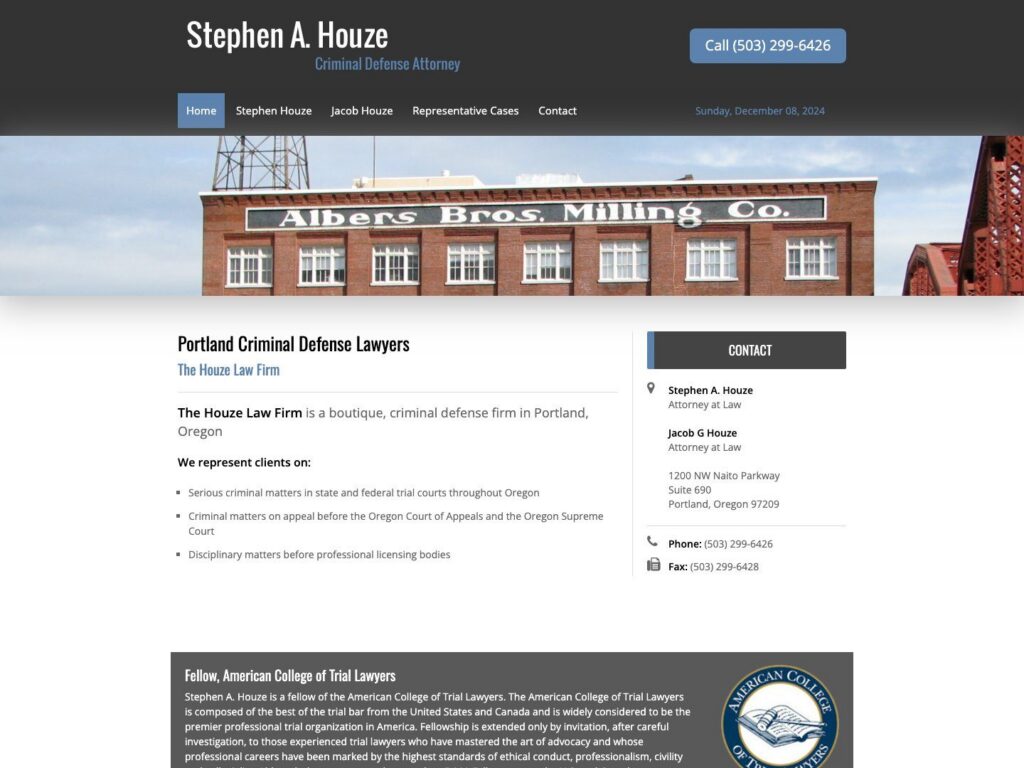
Houze Law Firm: a restrained site for a two-attorney defense practice

Houze Law Firm is a Portland, Oregon criminal defense practice with two attorneys. Dan Gilroy Design built the firm's earlier site as well, and redesigned it when the practice had outgrown it.

Before Houze Law Firm homepage before the redesign
Public Wayback Machine capture, December 9, 2024. View source.
After Houze Law Firm homepage after the redesign

Problem

The earlier site was a short brochure: a firm description, two attorney links, representative cases and long explanations of awards. It documented the firm's experience but not the kind of cases it handles, and it no longer set a high-stakes defense practice apart from a conventional small-firm website.

Constraint

Criminal defense websites lean on urgency. The firm wanted none of that, and still needed a visitor in trouble to find the right attorney quickly.

Decision

Black-and-white portraiture, a restrained dark palette and sharper positioning signal discretion and authority at once, with a dedicated path for each practice, notable case stories and a clearer structure on phones.

Stephen A. Houze Stephen A. Houze Houze Law Firm Client testimonial

Working with Dan Gilroy was an absolute pleasure. His designs are creative and tailored to meet his clients' tastes without sacrificing the dignity of our profession.

Hicks Thomas: a clearer route through a 40-attorney Houston trial firm

Hicks Thomas is a Houston litigation firm with more than 40 attorneys handling business, tort, energy and environmental disputes. Its redesign launched in 2025.

Before Hicks Thomas LLP homepage before the redesign
Public URLScan capture, April 12, 2024. View source.
After Hicks Thomas LLP homepage after the redesign

Problem

The former homepage led with a Chambers USA 2021 ranking and a quote from it, and the attorney menu listed dozens of names at the same level. The firm's depth was real, but a visitor had to scan a long way to get from its reputation to the right lawyer or practice.

Constraint

More than 40 attorneys and litigation practices from business and tort to energy and environmental disputes had to stay easy to reach without making the firm feel institutional.

Decision

Lead with the line "Hustle Never Sleeps" over a night-time street photograph, group related practices, tighten the main navigation, and give attorneys and firm news more visible routes.

Colin Watterson Colin Watterson Partner, Hicks Thomas LLP Houston, TX Google Review

Dan Gilroy did an incredible job designing the new Hicks Thomas website. His customer service was outstanding -- responsive, thoughtful, and always willing to go the extra mile. What impressed me most was his efficiency, quickly ensuring a smooth process from start to finish…

Miller & Wagner: the same promise, with the full range of cases in view

Miller & Wagner is a Portland, Oregon firm of three attorneys that handles only medical malpractice cases, for clients across Oregon and Western Washington. Its redesign launched in 2025.

Before Miller & Wagner LLP homepage before the redesign
Public Wayback Machine capture, December 15, 2024. View source.
After Miller & Wagner LLP homepage after the redesign

Problem

The previous homepage stated the firm's specialty and its trust line clearly, then named only a few kinds of injury before moving on to attorney profiles and general information. Much of the firm's case range sat several steps away.

Constraint

The site had to stay focused on a single specialty while showing how many kinds of cases fall within it, and the firm's existing headline was worth keeping.

Decision

Keep "Doctors Respect Us. Attorneys Know Us. Clients Trust Us." as the headline, add a homepage grid of malpractice case types, and give recent wins, the attorneys and the inquiry form clearer places on the page.

Conor Jones Conor Jones Miller & Wagner LLP Google Review, January 2026

Working with Dan Gilroy was a breeze, he was responsive to our needs, had great design ideas, and we are very happy with the final product. We will return with all our website needs in the future.

What happens to your current site

A redesign is not a fresh start, and it shouldn’t be. By the time a firm decides to redesign, the current site has usually been doing quiet work for years. Former clients and referring lawyers search for the firm and its attorneys by name and land on the biographies. A few practice pages or articles bring in searches every week. Other websites link to particular pages. Dan Gilroy Design starts every redesign by finding that work, so the new site keeps it.

Most of what the firm already has carries over. The domain stays the same in almost every case. So do the page addresses wherever possible, which means most pages need no redirect at all. Attorney biographies, practice pages and articles move into the new site and are edited for consistency rather than written from scratch; when a page needs new writing, it’s quoted separately. Testimonials and case results carry over word for word, and the firm’s attorneys confirm that each one meets the advertising rules where the firm practices. Google Analytics and Search Console continue, where the firm has them, so the history stays in one place.

What changes is the design, the structure and the way the site is built. The new site is a custom WordPress theme with no page builder, presented first as a working, password-protected website. Contact forms are rebuilt and test-sent to every recipient before launch. Addresses change only when they have to, because one was made of numbers and symbols or because two pages are being combined, and every changed address that still draws searches or links gets a permanent redirect to the closest new page. Before changing an address that draws real traffic, or many addresses at once, Dan Gilroy Design tells the firm, and the firm or its SEO team can refuse the change. Hosting moves to secure managed WordPress hosting unless the firm’s current host is suitable.

What stays

  • Your domain name
  • Page addresses, wherever possible
  • Attorney biographies, edited for consistency
  • Practice pages and articles that still draw searches
  • Testimonials and case results, word for word
  • Google Analytics and Search Console history

What changes

  • The design
  • The structure and navigation
  • The build: a custom WordPress theme, no page builder
  • Contact forms, rebuilt and test-sent
  • Any address that must change, redirected
  • Hosting, if the current host isn’t suitable

What seven recent redesigns showed about search after launch

The first question most partners ask about a redesign is whether the firm will lose the search visibility it already has. To answer with something better than reassurance, Dan Gilroy Design looked at Google Search Console data for seven law firm websites it redesigned between September 2025 and September 2026, reading each from its launch through October 27, 2026. Search Console counts Google searches only, not calls, referrals or visits from other sources, and seven sites is a small group. With those limits in mind, three patterns stood out.

  1. At business and litigation firms, the biographies drew most of the clicks

    At three of the four multi-attorney business and litigation firms, attorney biography and team pages drew between 54% and 74% of all Google clicks after launch. Practice pages appeared in plenty of searches but drew a much smaller share of clicks. For a redesign, that means the biographies deserve the same care as the homepage, and their addresses should stay put.

    Firm A26%
    Firm B54%
    Firm C65%
    Firm D74%
    Share of Google clicks landing on attorney biography and team pages after launch, four business and litigation firms
    Share
    Firm A26%
    Firm B54%
    Firm C65%
    Firm D74%
    Share of Google clicks landing on attorney biography and team pages after launch, four business and litigation firms.
  2. How much of the audience is on a phone depends on the practice

    Phones accounted for 31% to 45% of Google clicks at the business and litigation firms, and 56% to 63% at the firms that serve individuals. A general mobile statistic doesn't settle much. A redesign should be planned around the firm's own Search Console device report, and reviewed on a phone as carefully as on a desktop.

    Business and litigation firms

    31%
    35%
    35%
    45%

    Firms serving individuals

    56%
    63%
    63%
    Share of Google clicks from phones after launch, seven firms grouped by the clients they serve
    Share
    Business and litigation firms, firm 131%
    Business and litigation firms, firm 235%
    Business and litigation firms, firm 335%
    Business and litigation firms, firm 445%
    Firms serving individuals, firm 556%
    Firms serving individuals, firm 663%
    Firms serving individuals, firm 763%
    Share of Google clicks from phones after launch, seven firms grouped by the clients they serve.
  3. When an address changes, Google catches up within weeks

    Most page addresses stay the same in a Dan Gilroy Design redesign, so most pages need no redirect at all. When an address does change, Google keeps showing the old one for a short time, and the redirect takes each visitor straight to the new page, so nobody lands on an error. At the four sites where we measured it, old addresses made up 15% to 41% of search impressions in the week of launch and fell into single digits within six weeks. That is the normal handoff Google describes for a site move. It is also why every redirect is tested on launch day and left in place for at least a year.

    Firm A
    Firm A: 33% in week 0, 5% in week 602550%Week 0: 33%Week 1: 21%Week 2: 12%Week 3: 11%Week 4: 6%Week 5: 6%Week 6: 5%33%5%Week 0Week 6
    Firm B
    Firm B: 35% in week 0, 4% in week 602550%Week 0: 35%Week 1: 28%Week 2: 26%Week 3: 22%Week 4: 7%Week 5: 4%Week 6: 4%35%4%Week 0Week 6
    Firm C
    Firm C: 41% in week 0, 7% in week 602550%Week 0: 41%Week 1: 36%Week 2: 26%Week 3: 22%Week 4: 27%Week 5: 15%Week 6: 7%41%7%Week 0Week 6
    Firm D
    Firm D: 15% in week 0, 0% in week 602550%Week 0: 15%Week 1: 7%Week 2: 3%Week 3: 0%Week 4: 2%Week 5: 0%Week 6: 0%15%0%Week 0Week 6
    Share of each site's Google impressions still going to old addresses (and redirected to the new pages), weeks 0 to 6 after launch, four firms
    Week 0Week 1Week 2Week 3Week 4Week 5Week 6
    Firm A33%21%12%11%6%6%5%
    Firm B35%28%26%22%7%4%4%
    Firm C41%36%26%22%27%15%7%
    Firm D15%7%3%0%2%0%0%
    Share of Google impressions still going to old addresses (and redirected to the new pages), weeks 0 to 6 after launch. Four firms, unnamed.

Google says to expect temporary ranking fluctuation during a site move, settling over time (Google Search Central). These observations from a few sites don’t change that, and they aren’t a promise about any one firm.

Source: Google Search Console for seven law firm websites redesigned by Dan Gilroy Design, September 2025 to September 2026, each read from launch through October 27, 2026. Percentages compare each site with itself. No firm is named, and no figure is attributed to a named firm.

Questions attorneys ask before a website redesign

Does a lawyer website redesign cost less than a new website?

No. A redesign is a new website, with a new structure, design and build, so Dan Gilroy Design prices it the same way. The planning ranges on the pricing page apply, and the written proposal sets the exact price for the firm’s page count, migration and writing.

Will we lose our Google rankings when the site changes?

No one can guarantee rankings through a relaunch. Google says to expect temporary changes, and that it can take a few weeks or more for new addresses to replace old ones in results (Google Search Central). What protects existing visibility is keeping the pages that already rank at their current addresses, giving every changed address that still draws searches or links a permanent redirect to its closest new page, leaving those redirects in place for at least a year, and watching Search Console after launch. That is how every Dan Gilroy Design redesign is run.

How long does Google take to switch to the new page addresses?

Usually a few weeks, and visitors aren’t affected in the meantime: a redirect takes anyone who clicks an old address straight to the new page. Most addresses don’t change in a Dan Gilroy Design redesign at all. In Dan Gilroy Design’s Search Console data from four recent law firm redesigns, old addresses made up 15% to 41% of search impressions in the week of launch and fell into single digits within six weeks. Google recommends keeping redirects in place for at least a year, and longer is better for anyone who saved an old link.

Do you rewrite our existing content or move it over?

Both, page by page. Existing biographies, practice pages and articles move into the new site and are edited for consistency as part of every redesign. Pages that need new writing, such as a practice the firm has added or biographies that no longer match one another, are identified in the proposal and quoted separately as law firm content writing.

Our current website is on a marketing company's platform. Can we move it?

Often, but it depends on the contract. Before giving notice, confirm who controls the domain name, ask for an export of your pages and images, find out who owns any tracking phone numbers, and make sure the firm has its own access to Google Analytics and Search Console. Contract terms vary, so read yours before you give notice. The redesign planning checklist covers the rest of what to gather before the project starts.

How do you handle testimonials and case results in a redesign?

They carry over word for word; Dan Gilroy Design doesn’t rewrite them. Advertising rules for lawyers differ by state, so before launch the firm’s attorneys confirm that each testimonial, case result and required disclaimer meets the rules where the firm practices.

Will the redesigned site work with AI search, such as Google's AI Overviews?

Google states that there are no extra requirements, special markup or AI files needed to appear in AI Overviews or AI Mode (Google Search Central). The same things that help ordinary search help there: clear pages, accurate information about the firm and its lawyers, and a site Google can crawl. The SEO and AI visibility page explains what is built into every site.

Does your firm need a website redesign?

Not every website problem needs a new website. Here are three common situations.

A full redesign

The site no longer matches the practice. Practice areas have changed, attorneys have joined or left, visitors can't find their way around, or the site is hard for staff to update. A redesign replaces the structure, the writing and the design together.

A focused refresh

The structure still works, but the design looks dated or the most-read pages are thin. Updating the design, the photography and the key pages can be enough, and if it is, the proposal will say so.

Something outside the website

If calls go unanswered, form messages reach the wrong inbox, or referred clients never call, a new design won't fix that on its own. Look at how inquiries are received and handled before deciding to redesign.

What every redesign includes

The proposal sets the exact scope, but every Dan Gilroy Design redesign includes the following work.

A review of the current site

When the firm has Search Console, we review which pages appear in Google searches, which draw clicks and which have links from other sites, and we go through what the firm wants to change.

A page and redirect map

Every current page is kept, combined or retired. Existing addresses stay the same wherever possible, and every changed address that still draws searches or links is mapped to its closest new page.

Content moved and edited

Biographies, practice pages and articles move into the new templates and are edited for consistency. New writing is quoted separately.

Custom design and WordPress build

A custom theme with no page builder, first presented as a working, password-protected website.

Mobile, speed and accessibility checks

Every template is tested on phones, tablets and desktops, checked for speed, and reviewed for keyboard use, contrast, headings and form labels.

Launch checks

Redirects are tested, every form is test-sent, and the new sitemap is submitted to Google Search Console.

The first weeks after launch

Included in the price. For the first few weeks, we check Search Console for missing pages and broken redirects while Google replaces the old addresses with the new ones.

Support after launch

We stay available for fixes and questions. Later changes can be quoted when needed.

How a redesign project works

The written proposal sets the schedule once the page count, the migration, the writing and the approval path are clear.

1. Conversation and proposal

On a Zoom call we go through the current site with you: what works, what doesn't, and what has changed in the practice. The written proposal follows.

2. Review, page map and content

After the agreement, first payment and questionnaire, we inventory the current pages and propose which to keep, combine or retire, with a redirect for every changed address that still draws searches or links. Existing content is edited into the new structure, and any new writing is scoped here.

3. Design and build

The first presentation is a working, password-protected website, with any new writing in place. Your team reviews it on desktop and phone, and we make the agreed changes.

4. Launch and the first weeks

We test redirects and forms, launch after final approval and the remaining payment, then check Search Console for a few weeks while Google picks up the new addresses.

Start with your current site's address and what isn't working.

Jonathan Bedi Jonathan Bedi Partner, Bedi & Singer LLP Chicago, IL Google review, October 19, 2026

Dan Gilroy rebuilt our firm’s website and nailed it. It came out better than I could have hoped for.

Read more client reviews

Start with your current website

Include your current website address and a few lines on what isn't working. The written proposal will show what carries over, what changes and what it costs.